

Hospital software company Alcidion has posted an impressive year with revenue up 27% to $51.6m, led by growth in the UK, plus a smart acquisition to consolidate market share in Australia. All this in the typically slower-moving market of hospital software.
This little company from Adelaide looks ready to take on healthcare behemoths Oracle Cerner and Epic at their own game.
They caught my attention with a well-priced acquisition of the Kyra flow products from Telstra Health.
A key focus for me at Terem Capital is making acquisitions in healthcare (although we look for software companies with under $10m revenue, a little smaller than Alcidion). So, the combination of healthcare and a good acquisition meant I just had to take a closer look at Alcidion.
This deep dive covers the usual aspects of the business:
About Alcidion
Business Model: Enterprise Software Solution
Market: Primarily Hospitals in Key Regions
Competition
Customer Value Proposition
Product
Go-to-Market
Finances
Key Risks and Scenarios
Valuation
Closing Thoughts
About Alcidion
Alcidion was founded in Adelaide by Ray Blight and Prof. Malcolm Pradhan in 2000.
Ray was the former Chief Executive of the SA Health Commission and Malcolm did his PhD at Stanford in medical informatics. Ray and Malcolm remained in key leadership roles with the business until 2019 and 2022 respectively.
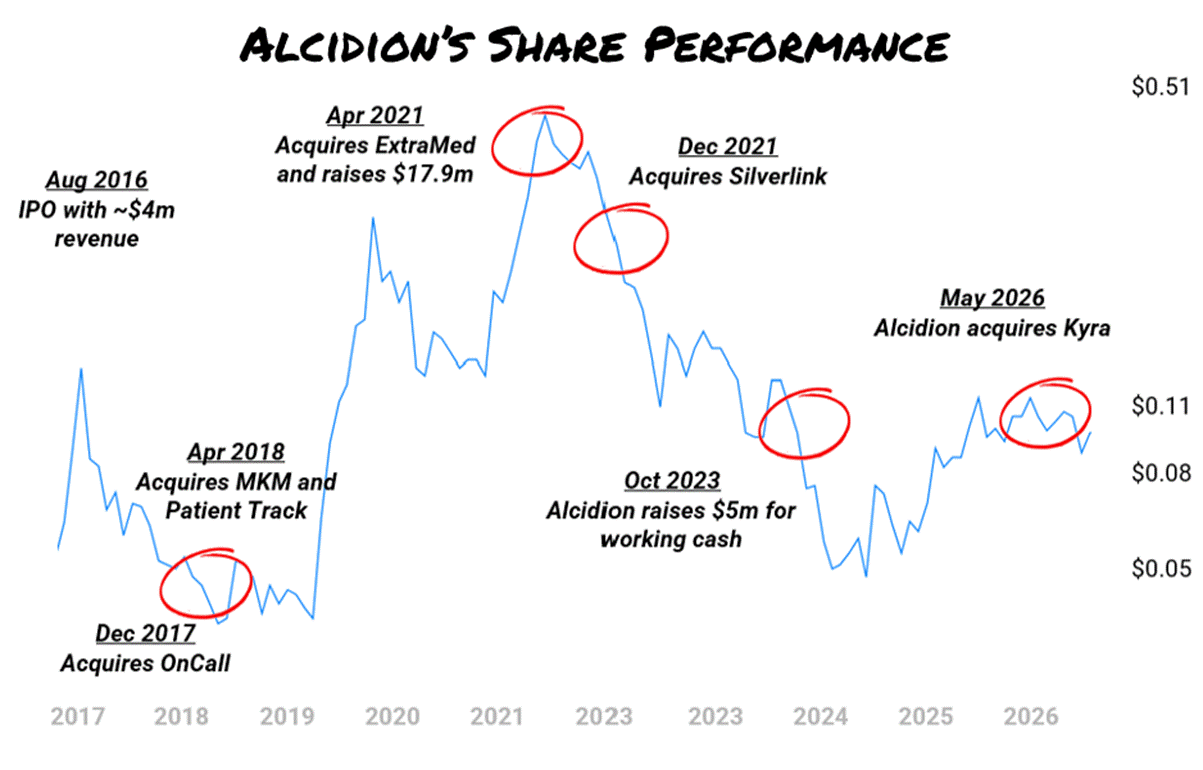
Alcidion listed through a reverse takeover of a minerals exploration company in 2016 (a common approach for tech companies at the time). The reverse takeover listing valued the company at approximately $12m and raised $2m on just under $4m of revenue.
Since listing, some of the key corporate activities have been:
2018: Raising $16.2m of new capital and acquiring Oncall, MKM and Patient Track.
2021: Raising $17.9m in new capital and acquiring ExtraMed and Silverlink.
2023: $5m capital raise.
Business Model: Enterprise Software Solution
Alcidion follows the standard Enterprise Software Solution business model: annual or multi-year software licences/subscriptions with an implementation fee and occasional professional services.
They have multiple modules that a healthcare provider can choose (they call these solutions). Their investor materials include a graphic that shows this well:
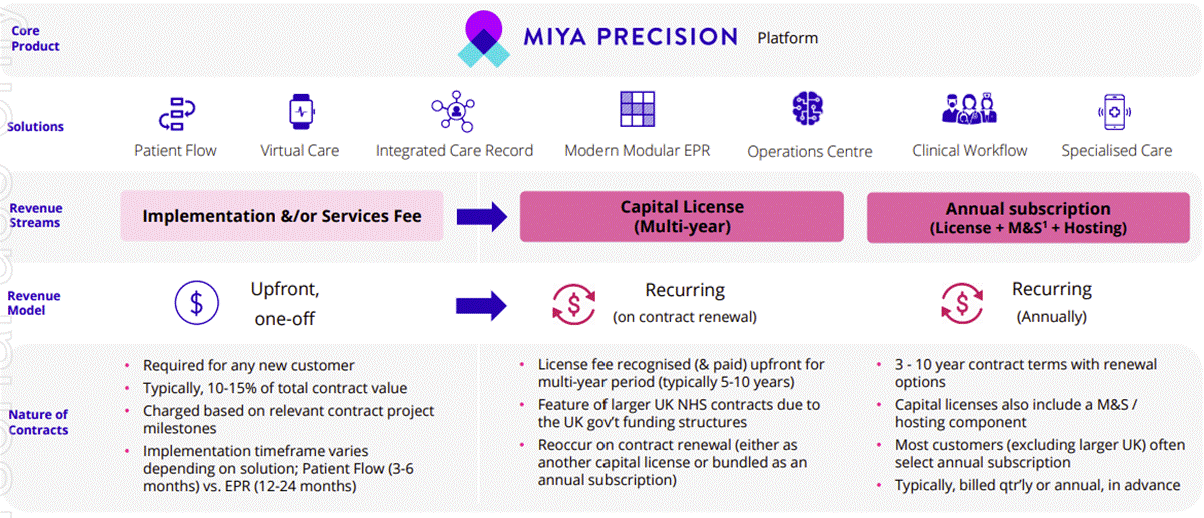
Customers start with a small number of modules, then, as they build trust and outcomes, look to solve more problems with additional modules.
Market: Primarily Hospitals in Key Regions
Alcidion’s primary customers are hospitals. Hospitals have a driving need for understanding patient journeys.
There are other organisations, like the Australian Defence Force (through Leidos), that use the software, but for our purposes the hospital market gives enough of an indication of the size of the opportunity for Alcidion.
The hospital market is best thought of by regions, due to the regulations and nature of hospital procurement. The regions are Australia, New Zealand, the UK and Canada. The Middle East is included because Alcidion mentions it as an area they are exploring (the FY26 annual report cites a “delivery partnership” and “early traction” there, but no named customers).
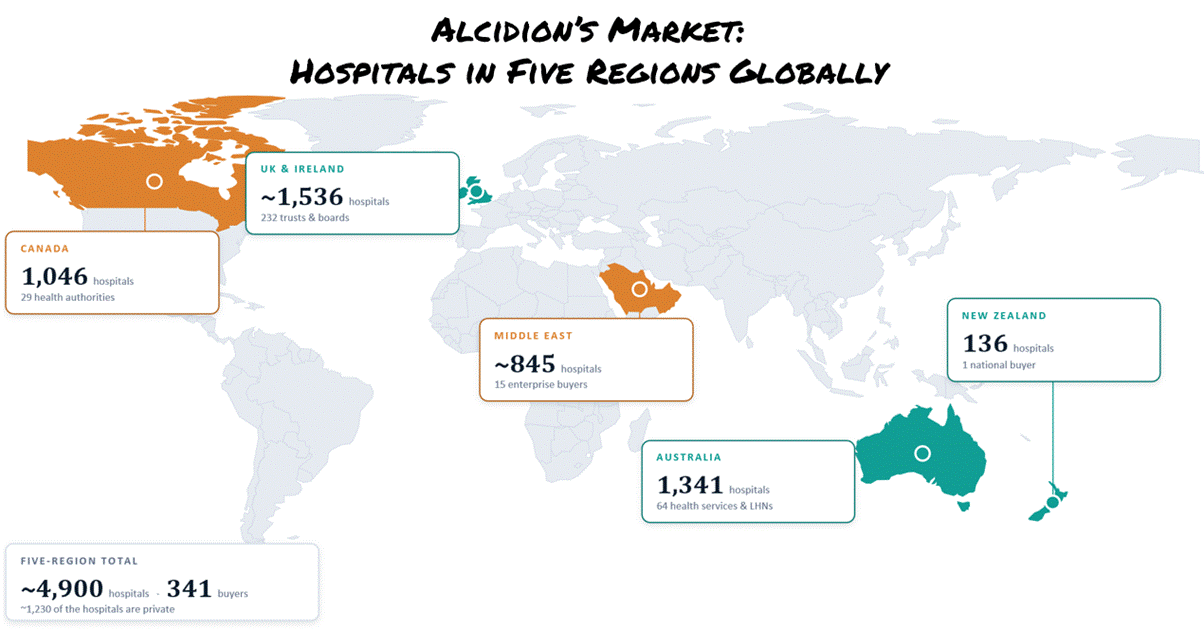
Beyond these regions, Alcidion can expand further globally, but each region comes with more effort than simply making a sale so expansion needs to be considered thoughtfully.
Competition
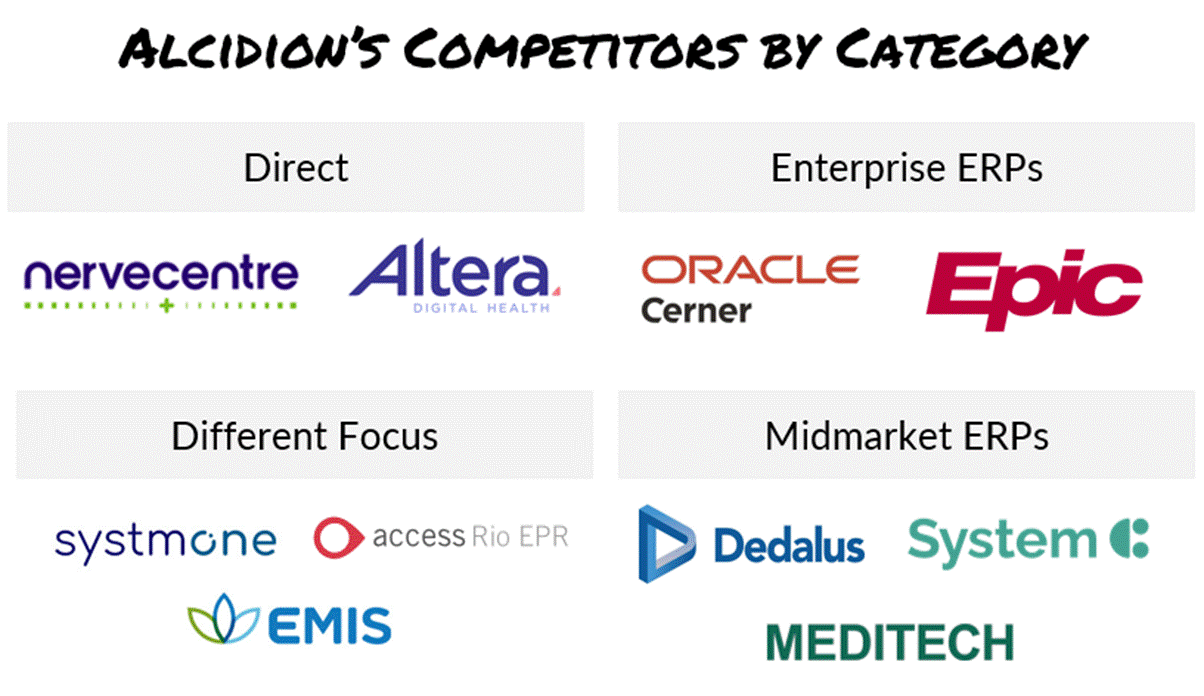
Alcidion’s competition comes in four different flavours:
Direct: other patient journey specialists with modular platforms for hospitals
Large EPRs: large systems that can run multiple hospitals, multiple types of healthcare services and most aspects of a hospital. These companies are behemoths.
Midmarket EPRs: smaller in functionality than the Large ERPs, but still powerful systems. Often best for a single hospital or health service.
Different Focus: patient journey and electronic patient record software but for non-hospital services like community healthcare, mental health, child health, GPs and pharmacies.
The Different Focus competitors are often installed in a different part of the hospital or healthcare service alongside Alcidion’s solution. But, they also have the potential to compete or overlap.
The Large ERPs are both competitors and partners.
Customer Value Proposition
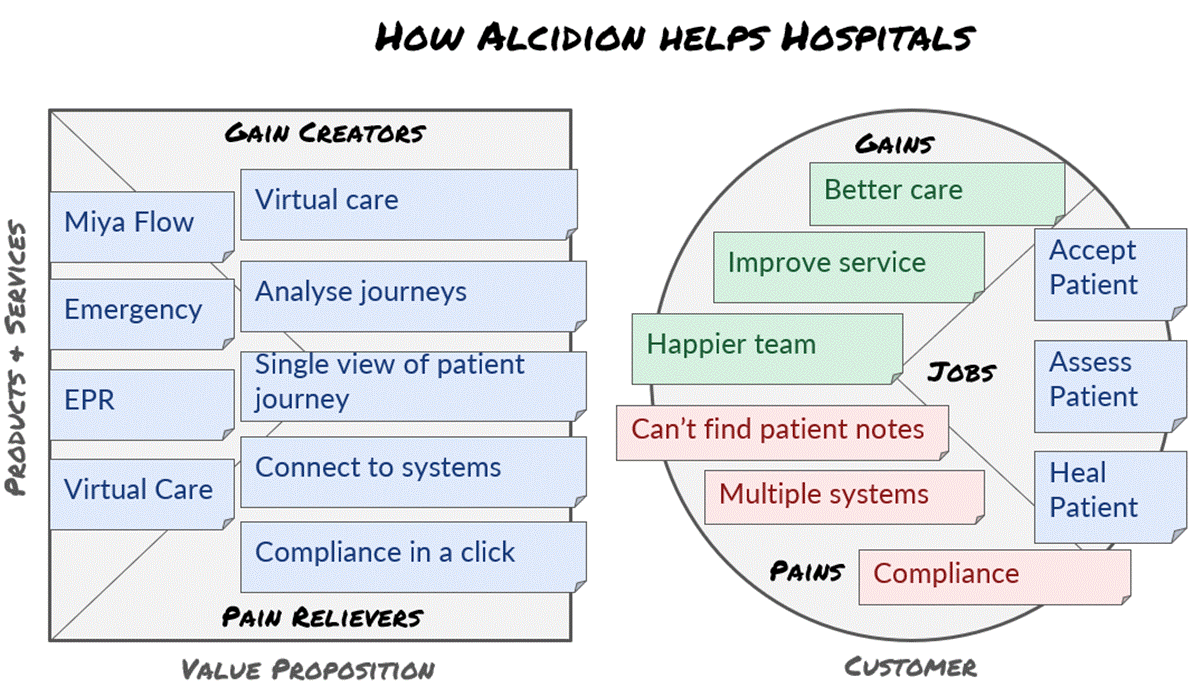
Alcidion’s core value proposition revolves around digitising each step of a patient’s journey, including bringing together multiple systems and data points into one view.
Product
Alcidion’s four products are:
Miya Flow: the core patient journey platform.
Miya Emergency: a solution for emergency departments and services specifically, where the need for a single view and efficiency is stronger.
Miya EPR: Alcidion’s Electronic Patient Record (EPR) system manages a patient’s medical history, test results, and prescribed medications in a single digital record.
Miya Virtual Care: a solution for care that is done outside the hospital (e.g. at home).
It’s worth noting that you can understand a patient’s journey without being the system that manages the Electronic Patient Record. For example, Miya Flow often integrates with Oracle Cerner’s EPR system rather than Miya EPR.
Go-to-Market
Alcidion appears to use a standard “enterprise sales” go-to-market centred on direct customer relationships through experienced sales executives. This is then supported by thought leadership (speaking, content and webinars).
Finances
Alcidion has grown revenue for the last two years, from $37.1m in FY24 to $51.6m in FY26, and has returned to profit after losses in FY23 and FY24. This largely seems driven by growth in the UK.
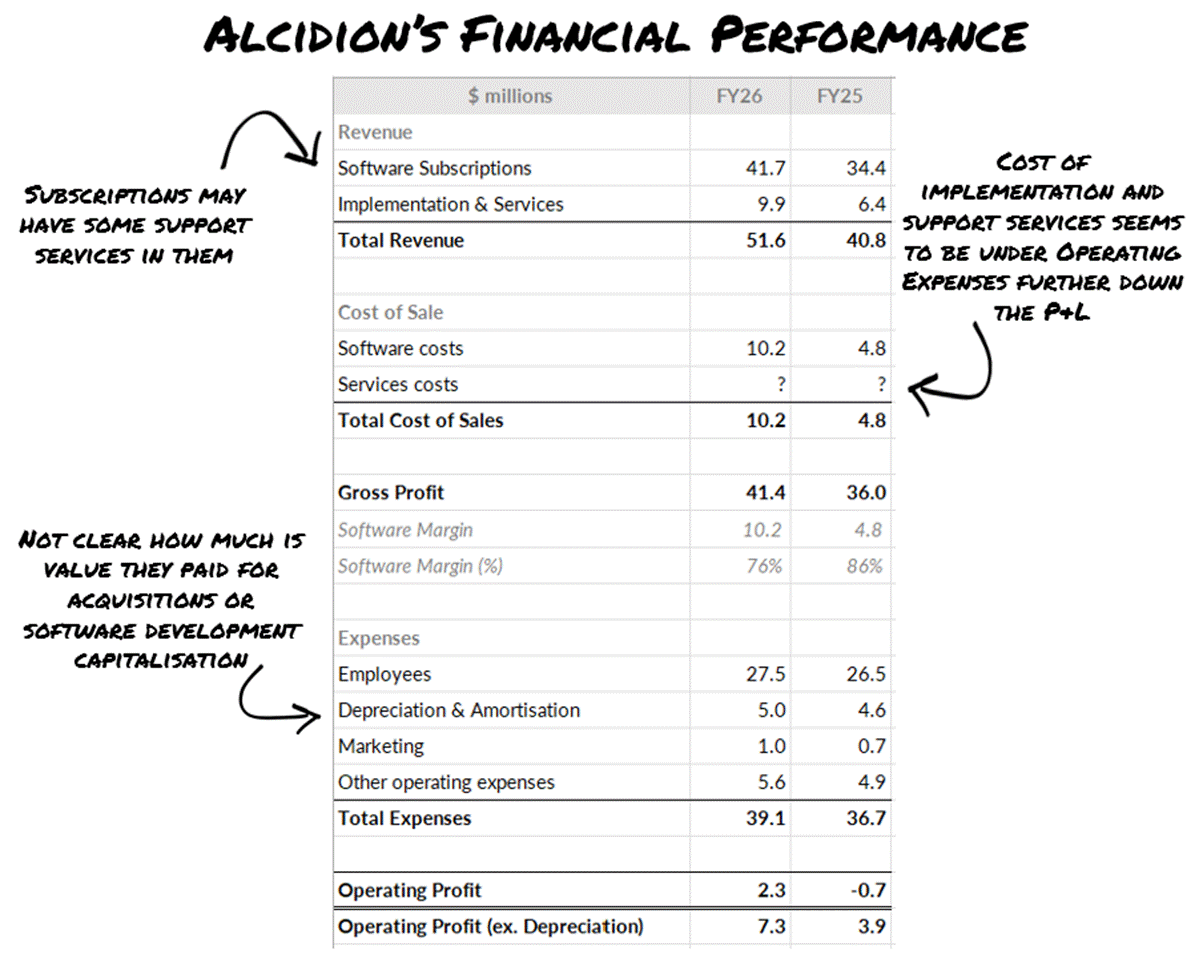
There are a few issues around their finances that are explored below.
#1 Software revenue isn’t as straightforward as it seems
Alcidion has two types of software revenue that, at their core, are customers subscribing to software over one or more years. However, they are treated slightly differently with one being a typical recurring subscription and the other being a capital licence (due to the way the NHS procures).
The typical subscriptions work as expected on the P&L but the capital licences appear to come in one-off spikes. The capital licence revenue is booked on delivery “rather than evenly over the term of the software licence which typically ranges from 12 to 60 months” (according to their FY24 and FY25 annual reports).
This means their annual recurring revenue (ARR) requires some analytical work to understand, spreading out the capital licences.
The table below gives an estimate of what annual recurring revenue from software might be, if the capital licences are annualised (assuming a three, five or seven-year licence term).
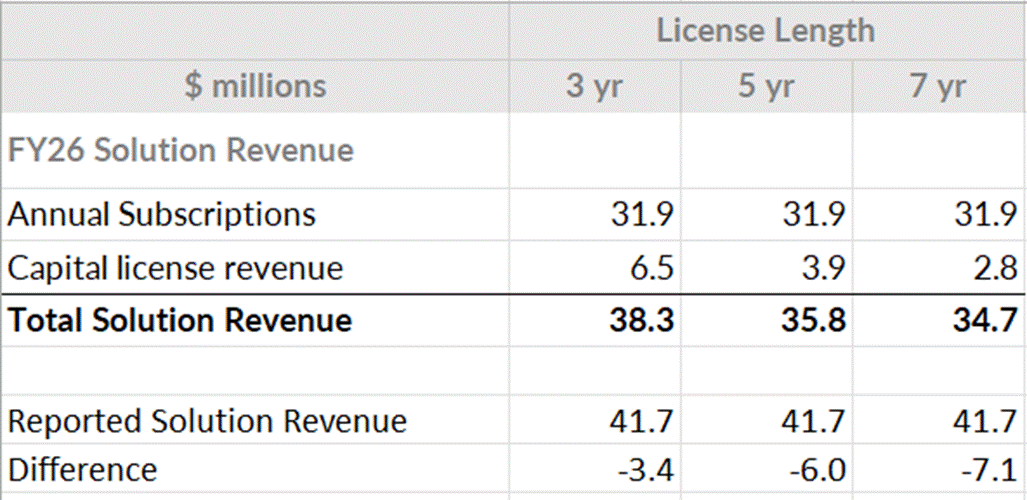
If this is the case, the business is less profitable, or even loss-making, when software revenue is recognised in a more “regular” way. On a three-year licence term, FY26 Operating Profit of $2.3m becomes a loss of about $1.1m.
#2 Cost of sales likely excludes implementation costs
The cost of sales, and thus gross profit, isn’t entirely clear and may not reflect the true cost of sales.
The reported direct costs appear to be costs associated with the software only.
If implementation services were in then you would expect cost of sales to jump around proportionally in FY23 and FY24, when recurring revenue was flat ($28.1m to $27.3m) but services revenue fell ($12.3m to $9.8m). Instead, direct costs only moved from $5.6m to $5.1m. Implementation is likely being borne by the team found under the employee section of expenses.
Key Risks
Given Alcidion’s proven ability to win new customers, deliver for them and retain them, the key risks for Alcidion are more around how big their future can be:
Growth: retaining existing customers while winning new customers in a slow-moving industry
Customer/region concentration: three customers each account for more than 10% of revenue (North Cumbria was 24% in FY25 and 12% in FY26). The UK accounts for 63% of revenue and this is caught up in a fairly politicised budget for the NHS. UK procurement delays are cited by Alcidion from time to time as issues in recognising revenue or winning contracts.
Government-wide lockout deals: In healthcare, governments and regions often do “enterprise wide” or “whole of government deals” with large vendors like Cerner or Epic that can push out smaller players. The UK’s NHS even tried to create its own system which failed spectacularly. This could force existing customers to leave and shut Alcidion out of new deals.
Tech platform rebuild: the tech platform has come together over several acquisitions and many years. This usually indicates a rebuild may become necessary. Throw in AI and there may be major work, at the very least, to get agentic engineering and other AI-style features working well. This can slow down sales and lead to churn (due to missing competitive features), as well as lead to increased costs to fund the rebuild.
Delivery constraints: large hospital rollouts rarely go to plan and you can only take on so many of them at a time in an economical manner. Even if the contracts are there to win, it can be hard to run them simultaneously, which leads to delays in revenue growth at best and customer churn issues or lawsuits at worst.
Key Scenarios
The key scenarios for this business are:
Current Growth Track: Alcidion continues growing through winning more hospitals and customers in their current regions. In this scenario, at some point the business needs to shift to higher profitability as it becomes more and more established.
Growth in more regions: Alcidion decides to keep expanding the regions they can serve. This would mean continued investment in functionality and sales teams for the regions, leading to lower profitability or maybe short term losses (given where profits are today).
Growth as an EPR vendor: Alcidion’s broader solution, centred on being the electronic patient record system, breaks through and starts winning from Oracle or Epic. Given the stranglehold Oracle and Epic have had in larger health services, new players have an opportunity to offer something different and with Alcidion’s EPR contracts at Sussex and North Cumbria this is a real possibility.
Lockout: One of the larger players (Oracle/Epic) engineers a whole-of-region deal that pushes Alcidion out of the market. This would take time to roll through to a decline in revenue for contractual reasons and switching issues, but it would eventually reduce revenue by substantial amounts. This will be hard to win back given the pace of procurement in health. It’s worth noting the lockout could work in Alcidion’s favour if their EPR wins.
Valuation
Here’s what the valuation looks like under each scenario.
The business currently has an enterprise value of $114m, at ~49x Operating Profit or 15.7x Operating Profit (ex. Depreciation). On revenue, it’s trading at ~2.2x.
(Operating Profit refers to the Operating Profit we used in the Finances section).
Current Growth Track
Given the long sales cycle and nature of the contracts, the FY27/FY28 results are somewhat knowable in advance. A line-of-sight view, built from reported contracted revenue and recent win rates, puts revenue at around $55m in FY27 and $61.5m in FY28. It could be a bit higher than this. At today’s multiples this would lead to a $121m valuation based on revenue.
If they can bring costs down while they continue to expand revenue in the regions then Operating Profit could move up substantially. The business could do $8m to $9.5m+ in FY27 and FY28 respectively. Interestingly, this delivers a better valuation on today’s Operating Profit (ex. Depreciation) multiple of 15.7x ($125m/$149m valuation).
Additionally, given the delivery of the contracts is somewhat locked in, the cost to service them and build software isn’t as high. So EBITDA could be even higher, giving some room to improve profitability if revenue slows.
The caveat to all this is some uncertainty around whether the capital licences could be better annualised/accrued like annual recurring subscriptions which would have minimal impact or reduce Operating Profit substantially. Otherwise the timing of the wins matters a lot for profitability (i.e. they need to keep winning new capital licences to keep this revenue line up in a given year). There’s also limited visibility over churn.
Growth in More Regions or as EPR Vendor
Both of these scenarios are somewhat similar. Neither is likely to impact revenue in the coming year, but they could have an impact in FY28. That is, winning a new customer in the Middle East or winning more EPR contracts this financial year (FY27) is likely to start getting recognised in FY28.
These would accelerate revenue growth but possibly at some cost (to deliver or improve/change the software). So it’s difficult to assume an improvement to profitability without deliberate cost restructuring by management (which doesn’t seem to be on the cards).
That being said, you can run the argument that they’re already in a good position to win these profitably and sustainably in an incremental way, with their current structure and software.
What it does mean in the long term, particularly with larger EPR contracts, is that revenue could jump to ~$100m in the next 3–5 years as the EPR contracts can be for $10-$50m each.
If they have to raise or spend to get there, then Operating Profits would be depressed, but if they don’t then this would deliver meaningful profits.
Lockout
A lockout is unlikely to hit revenue for at least three years. Even if a lockout happened in the UK or an Australian region within the next year, it would take a few years to come into effect (again, unlikely given no indication of this).
Meaning, even if a “lockout” happens, the profitability and revenue valuations under the “Current Growth Track” are still achievable over the next 3–5 years because that’s how long (at a minimum) these lockouts would take to have an impact on revenue if they happened in the near future.
Closing Thoughts
Alcidion has a strong line of sight around contracted revenue with a solution offering that has the potential to keep moving up in the value it provides to customers. It looks like this might even be possible without major capital investment thanks to the investments made to date in the platform.
The growth looks sustainable, although capital licences make it lumpy year to year.
The questions around the future are whether big capital licences can keep helping deliver profits, whether all the costs are necessary when delivery slows, and how soon the payoff comes for investing in the platform and new regions.
This email is general information and commentary only. It is not financial product advice or a recommendation to buy, sell or hold any security.