

The usually sleepy super fund software space is receiving unusually hot interest right now.
Grow Inc was just acquired by pension fund solution behemouth MUFG (who also acquired Link).
I took a look at ASX-listed super fund payment processor, Wrkr.
Wrkr has partnered up closely with serial super software acquirer MUFG. This partnership will likely boost Wrkr’s revenue significantly.
But is the growth already priced in? Can Wrkr break into new markets through its new partnership, or will MUFG gobble up Wrkr as well?
Let’s dive in.
This deep dive covers the usual aspects of the business:
About the Wrkr: Super payment processing and more
Business Model
Customer Value Proposition for Super funds
Market: Employee payments is really three markets
Competition: Competition on Multiple Fronts
Go-to-Market: Enterprise Sales
Finances
Key Risks and Scenarios
Valuation
About Wrkr: Super payment processing and more
Wrkr provides compliance services and software across payroll, employee payments and superannuation.
Wrkr is the result of multiple companies coming together through M&A.
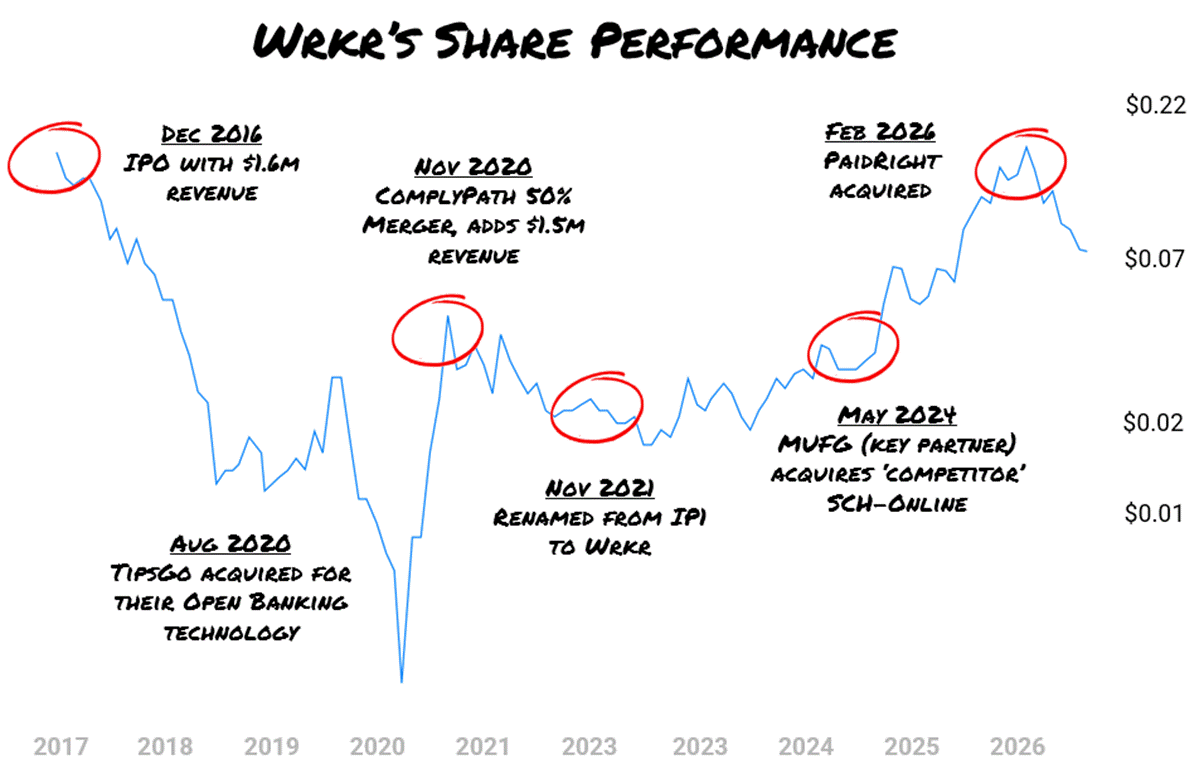
Wrkr’s beginnings start with Payment Adviser Group in 2007. Payment Adviser Group went on to acquire ClickSuper in 2013.
Payment Adviser Group was listed as InPayTech Limited (ASX: IP1) in December 2016 with a $3-5m IPO at a market capitalisation of ~$29m with ~$1.6m of revenue and ~$0.8m of losses.
In 2020, Wrkr completed two acquisitions. One was to acquire TipsGo for its open banking technology and the other transaction merged ComplyPath with the group. ComplyPath added $1.5m in licensing and consulting revenue at the time as well as a better software platform for IP1’s payroll, super and employee payments offerings. ComplyPath was developed as a venture within PwC Australia and spun out as a standalone business.
The group renamed from IP1 to Wrkr in November 2021. The group has gone to market fairly regularly for additional capital: ~$11m in FY24, ~$11m in FY25 and ~$15m in FY26.
In early 2026, PaidRight was acquired to expand from superannuation compliance to payroll compliance for scrip worth around $13.6m. PaidRight was originally a spinout from CSIRO’s Data61. Notably the Wrkr CEO was a ~16% shareholder of PaidRight at the time.
The Wrkr group is now focused on compliance and processing for super and payroll.
Business Model: Payment Processing for Super Funds
Wrkr’s business model focuses on providing the software and financial infrastructure to help super funds and others process payments to employees.
Wrkr makes it easy for paying super and payroll to take place. Businesses make one transaction to pay super for all their employees. That payment goes into Wrkr’s clearing house, which splits it into the right amount for each employee and distributes it to their superfund or bank account.
Wrkr charges an annual software license fee and implementation services to set up the Wrkr Platform for a superfund. Then they charge a transaction fee for processing each payment.
The movement of these payments also produces float, which earns meaningful interest income, accounting for 17.6% of revenue in FY26.
The interest and payment transaction fees fall under Wrkr Pay.
As part of all this, the Wrkr Platform makes sure the appropriate compliance and regulatory filings are made for businesses and superfunds to ensure they keep the ATO happy.
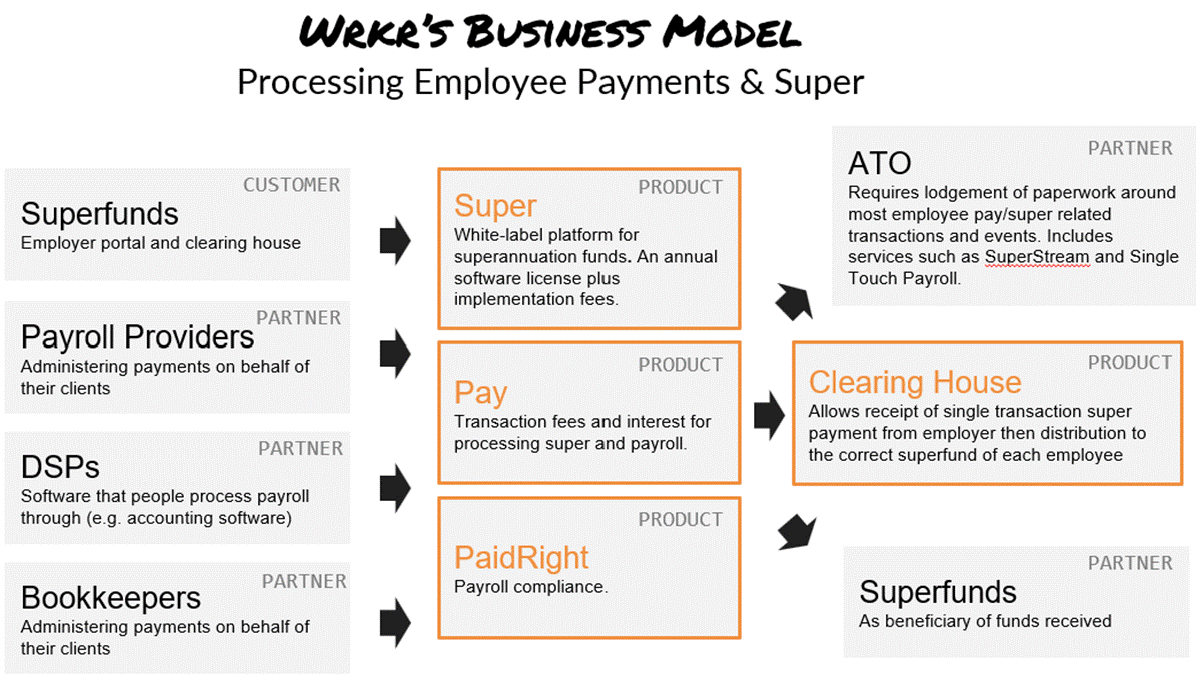
The model can be used for partners other than superfunds, such as payroll providers (firms who administer other companies’ payroll) and digital service providers (DSPs) such as accounting or payroll software.
Market: Employee payments is really three markets
It’s tempting to think of employee payments and compliance as a single market. It isn’t. The way this market is structured means there are several distinct ones.
Wrkr’s primary market is super payment processing. Then they’re also pursuing (i) payroll and (ii) wage compliance. They look similar. They are not.
Super Payment Processing
Super payment processing is best understood through the organisations employers actually pay super through. These are superfunds, banks, accounting software and payroll managers.
Super funds have agreements with larger employers to be the default fund and, as part of the agreement, they give the employer a payment portal to make super payments easy.
Software products in accounting, like Xero and MYOB, and payroll, like Employment Hero and ELMO, also provide out-of-the-box super processing.
Employers have a banking relationship from the moment they are established and will often look to that relationship for financial solutions, like payments.
The following tables give you a sense of the market:
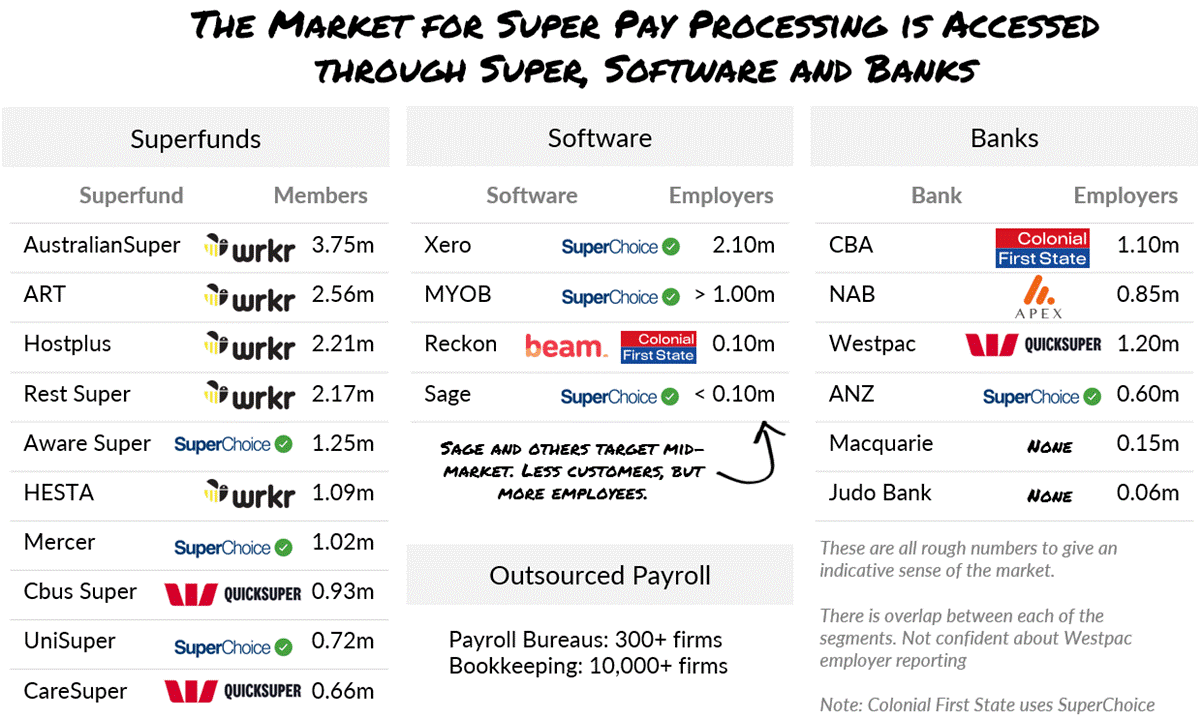
There are also firms that manage payroll for their clients, including bookkeepers, accountants and outsourced payroll firms. This is a more fragmented market and analysing it in depth isn’t necessary for this deep dive.
The big market share gains are found in serving software, superfunds and banks.
Payroll Processing
Australia has a large and demanding payroll processing market, defined by the complexity of compliance and regulations.
Correct calculation of pay means an understanding of the various laws, agreements and circumstances. On top of that, Single Touch Payroll reporting requires digital filing with the ATO on or before each pay event, so the money and the paperwork have to move fast.
Just like with super processing, accounting software firms already hold most of the small-to-medium end of the market. As employers get larger, they will look at outsourced payroll providers or more specialised software. Further up the market, ERP providers like TechnologyOne, SAP and Workday start to play a role.
It might look like payroll overlaps with super processing. There is less overlap than it first appears, particularly because Wrkr’s base is in superfunds, who sit some distance from direct access to payroll. The payroll market, for Wrkr at least, won’t get much leverage from their existing relationships.
Wage Compliance
The market for wage compliance audits and analysis has traditionally been performed by auditors and accountants that are already working with the employer.
The regulation and liabilities associated with underpayments means companies are paying more attention to this.
That has pushed the work towards software as a one-off audit and on an ongoing basis. The key being that the software can perform it faster, cheaper, more accurately and more regularly.
Competition on Multiple Fronts
Wrkr is competing on multiple fronts.
● In super they are up against the market leader SuperChoice and Westpac.
● In payroll, they are up against a highly fragmented and competitive market across market leading accounting platforms like Xero and MYOB, established outsourced payroll processing firms and accounting firms themselves.
● In wage compliance, they are up against other specialist software companies (like Yellow Canary) as well as the accounting firms and wage compliance specialists.
In each broad market they are competing in, they are not in pole position. However, look more narrowly at the “platform and clearing house for superfunds” and they are the market leader.
This narrow market definition and the competition there is shown below:
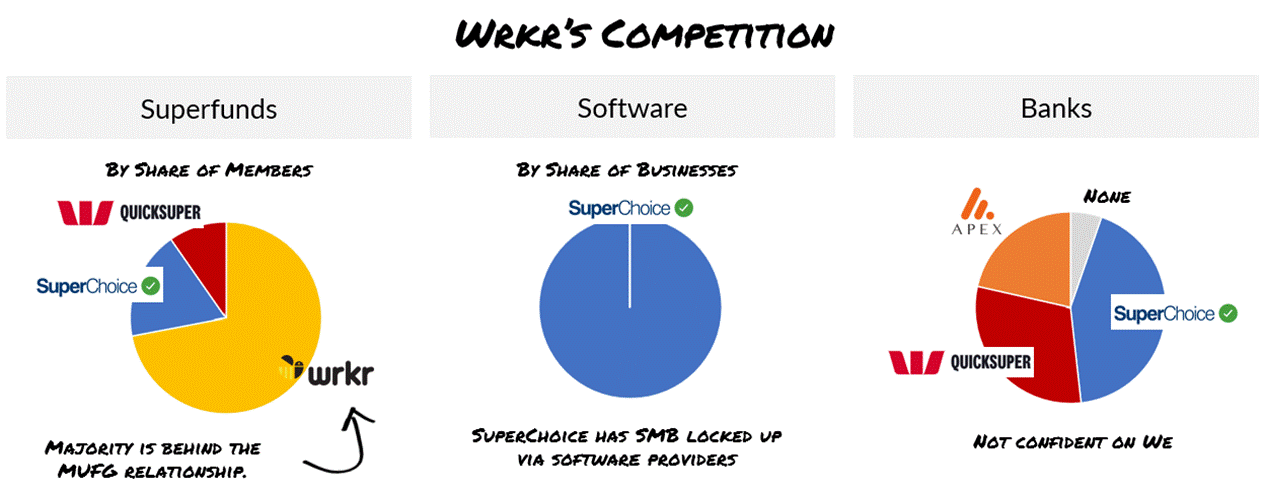
An interesting development is Wrkr’s key partner, MUFG, acquiring Super Clearing House Online (SCH Online) as part of MUFG’s acquisition of Link Administration. SCH Online’s technology wasn’t up to scratch, so MUFG is using Wrkr’s platform to power super payment processing for AustralianSuper and ART. This is a huge mark of confidence in Wrkr’s technology, given MUFG didn’t want to use the technology they just acquired.
Product
They have four products:
Super: processing super
Payroll: processing payroll
Credentials: helping onboarding and checking credentials important for pay
PaidRight: checks wage compliance against various regulations and agreements
It’s not clear what the revenue is for the Credentials and Payroll products.
Customer Value Proposition for Super Funds
It’s not clear how established the pay and credentials products are, so this analysis of the customer value proposition focuses on superfunds as the customer.
Wrkr’s platform ultimately helps superfunds win new members, because it lets them give employers simple infrastructure for making super payments.
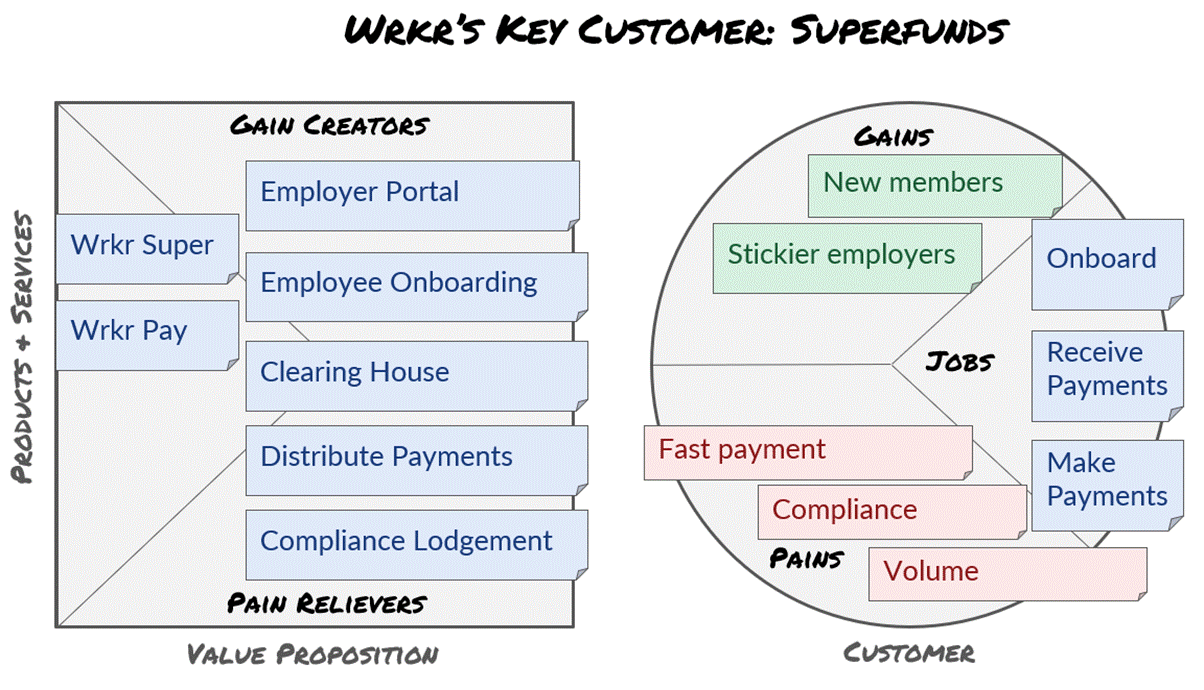
PaidRight doesn’t fit the superfund value proposition yet, but it could become another gain creator: superfunds helping their employer customers stay compliant and avoid the disaster of an underpayment event.
Go-to-Market: Enterprise Sales
The business is engaged in two different types of go-to-market. One targeting a small number of larger organisations (superfunds) and another targeting the employers.
Larger organisations are typically a more focused direct sales motion, while targeting employers en-masse (small-to-medium businesses) is a marketing motion.
They seem to be successfully selling into larger organisations like the superfunds using:
● Partnerships: they partner with organisations like MUFG, KPMG and others to provide their platform to superfunds and employers.
● Webinars: they run webinars covering superannuation payment topics
● App Marketplaces: they have an app in the Workday marketplace for larger employers to start using Wrkr.
They don’t appear to be geared up to market to SMBs or bookkeepers as their advertising and marketing spend is minimal. It’s not clear how they will reach them in the volume needed to move the needle.
Finances
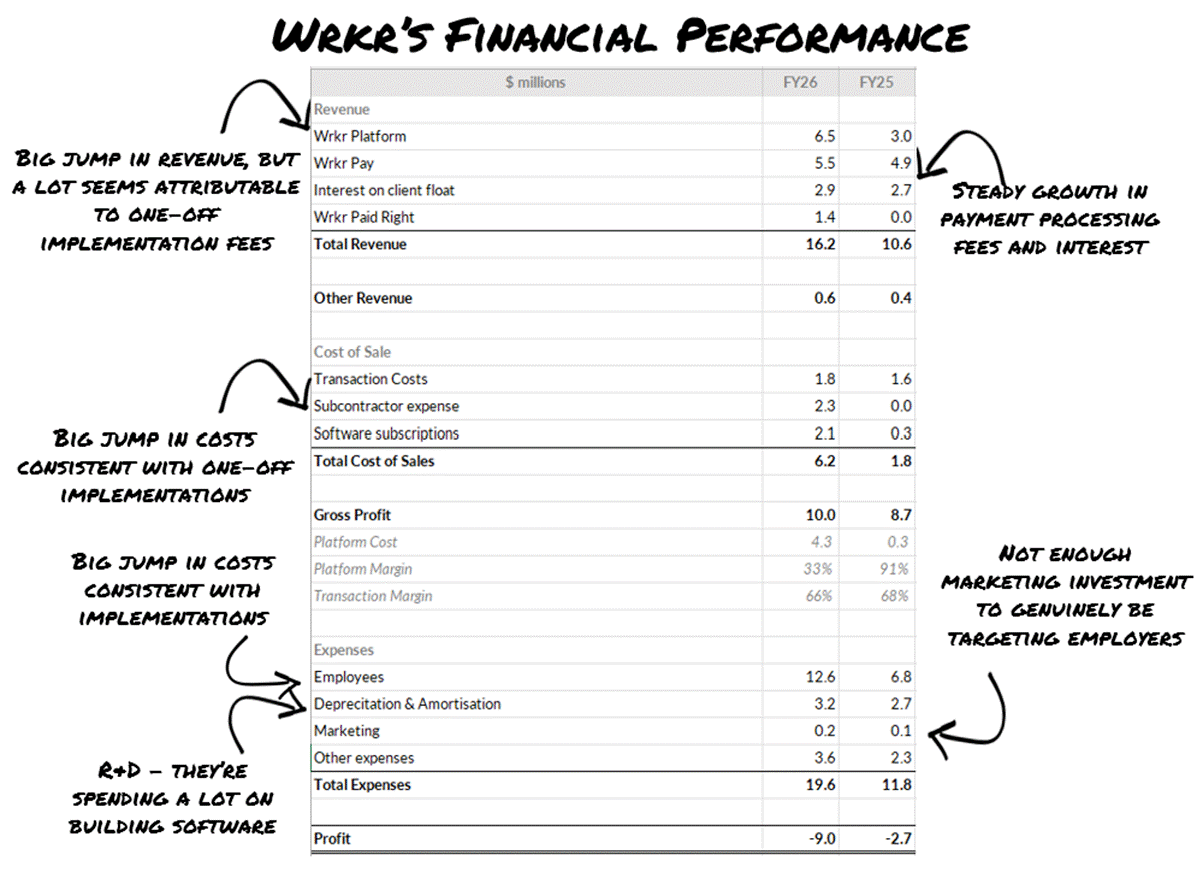
There are some challenges in understanding their financials:
Platform Revenue: Recurring and non-recurring revenue is lumped together as though it is recurring. The big jump in revenue in FY26 likely contains a significant amount of one-off implementation fees for the onboarding of ART.
Pay Revenue: the Director’s Report says Pay “includes interest on the clearing house funds held on trust” but the P&L on page 20 shows it as its own revenue line item.
Capitalised development: they are capitalising some of their software development costs.
Separation of Payroll from Super: it would be helpful to see these businesses detailed separately.
Key Risks
MUFG replaces them: this is unlikely in the short term having just invested in getting them set up for ART and AustralianSuper but in the medium to long-term MUFG might look to build this software and capability themselves (or acquire a competitor).
Can’t raise capital: with the losses they are incurring, their historical dependence on capital, and the obligations of the implementations they need to deliver, they may run into a wall if they can’t raise additional capital.
Can’t break new markets: they fail to make material headway into payroll and wage compliance. This substantially limits the future growth prospects of this business given they have such a large share of super now. Their growth is then somewhat tied to Australian super account growth (population growth) as additional funds that are with SuperChoice may be hard to shift.
Issues in delivering for ART/AustralianSuper: it’s common for there to be delays and problems on implementations of financial systems in complex enterprise environments like the implementation Wrkr is doing with MUFG and the big superfunds. These issues can lead to increased costs, delays receiving revenue or, worst case, losing a customer (even when it isn’t your fault).
Management focus: with management focus on delivering major programs for the Superfunds, it isn’t clear how much attention building for new markets (payroll, wage compliance) will get.
Unemployment: at a macro level, a broader economic downturn that cut employment or wages would drag the transactional revenue (essentially a percentage of wages) down with it.
You could argue regulation or changes to the super system are a risk to them, but it’s hard to envisage regulation doing anything but helping this business.
Key Scenarios
Four scenarios are worth holding in mind. They are not forecasts. They are the handful of futures that actually matter for what this business is worth, and each one turns on the same question: how quickly do contracted users become paying, contributing users?
Deliver the superfunds, minimal progress on other fronts: this is probably the most likely scenario.
In this world Wrkr gets their 4.4m contracted users live and contributing over the next two to three years. Recurring revenue climbs from the ~$9.9m FY26 base towards $35-45m as onboarded users start paying transaction fees.
PaidRight ticks along as a modest SaaS business, payroll integrations get built but don’t win much, and growth after FY29 settles back towards the underlying growth of Australian super accounts.
Wrkr ends up a good, small, profitable infrastructure business with one very large customer relationship and limited optionality.
Super delivers and new markets grow:
The PaidRight acquisition helps crack new market growth and make material progress with employers and accountants directly.
This is the scenario where the business stops being a technically advanced super clearing house with ambitions and becomes a broader employee pay compliance platform. It requires PaidRight’s SaaS transition to work, a very different go-to-market motion to the one they run today, and management attention they may not have spare.
Slowly build contributions: the contracts hold and are implemented successfully, but the contribution ramp takes longer than expected.
Employer adoption of Payday Super keeps running behind plan, the ATO stays soft on enforcement, onboarding friction persists, and the long tail of small business moves over years rather than quarters (this is what management themselves have flagged).
Revenue grows, but not fast enough to outrun a cost base that has already been built for the full 4.4m users. They burn through capital and come back to the market again, at a lower price, before the business turns cash positive.
Nothing is broken per se; everything just takes twice as long and costs shareholders another round of dilution.
Something big breaks contracted users: an existential risk rather than a likely one.
The plausible triggers are a serious failure in one of the implementations, MUFG deciding to bring the capability in-house or buy a competitor, or a capital raise that can’t be done on acceptable terms at the wrong moment to cover Wrkr’s spending habit.
Any of these would be severe because so much of the value here sits in one partner relationship.
Valuation
Wrkr was trading at A$0.075 a share with a market capitalisation of ~A$162m at the time of writing. The underlying enterprise value is around ~$140m at 10.7x FY26 revenue.
One Metric to Rule Them All
Almost everything about Wrkr’s value right now comes down to a single mechanic: contracted superfund users becoming contributing superfund users.
The company has contracts covering roughly 4.4m users. At 31 July 2026 about 0.78m of those users were live, meaning they were having contributions processed. The company’s own investor material uses about $7 of annual revenue per user (ARPU). If the ARPU is right, then the full contracted base is worth roughly $30m of recurring revenue, of which about $25m is still to come on top of the existing base.
This contributing superfund number has the clearest path of driving revenue growth and, ultimately, profitability. Not new markets, not PaidRight, not payroll; just converting a base they have already signed.
The gap between the 0.78m users actually contributing and the 4.4m contracted is the single biggest driver of the share price over the next three years.
Every quarter the climb to 4.4m slips is another quarter of losses, and probably another call on capital to fund the implementations that earn the revenue.
Directional Valuations
With that in mind, the key scenarios likely look like this:
Deliver the superfunds, minimal progress on other fronts: This gets the business to between $25m-$45m in revenue. If they do nothing about the cost base then they’re breakeven to profitable, but if you assume some of the costs go down as the heavy implementation work is no longer needed then they could be making $5m-$15m+ EBITDA. Given the infrastructure-like qualities, a 10x+ EBITDA multiple is a reasonable baseline, putting them at $50m-$150m. What’s interesting is that growth then caps out at roughly the speed of the economy, unless they can find new markets.
Super delivers and new markets grow: If you assume the superfunds deliver and then the wage compliance and payroll offerings grow, this is all incremental to the “deliver the superfunds” scenario. However, it’s hard to evaluate this given PaidRight’s relatively low revenue and (likely) losses. So you come back to the $50m-$150m baseline, and anything beyond that is speculative.
Slow grind: the superfunds take longer to deliver than expected. Under this scenario you need to assume some further dilution as costs will likely remain the same (requiring new capital) and that revenue ends up closer to the $25m eventually. It probably takes a little shine off the multiple. So it eventually lands in the ~$45m valuation range or lower.
Something big breaks: if something big breaks, which isn’t inconceivable in this business, then there is a world where the valuation quickly deteriorates.
Each of these leaves us in a place where the future looks fully priced in, unless the new markets can be cracked in a way that materially moves financial results over the next two to three years.
They could focus on the super business which would mean some costs could be shed. The market is capped, at least in Australia, but the profitability that would come with it gives the business strength. This seems unlikely given the recent PaidRight acquisition though.
The business, then, seems locked in on the these new offerings to new markets succeeding to beat expectations.